by Donna Page
This story is about a promise I made two and a half years ago. With a cancer diagnosis, dreams of travel were put on hold. After thirty years of marriage, all the children had left home, and we could finally travel the world. Sadly, those dreams were shattered when we lost the battle. We had talked about that outcome, and I was made to promise to make that dream happen, no matter what.
We had taken a cruise a year before we got the news. Darin, my husband, loved it. I was born to love the ocean, the daughter of an officer of the Royal Navy. When cruising, people always talk about sea legs. Finding difficulty walking on a ship and then even more difficulty when back on land is common; people will say, “You haven’t got your sea legs yet,” or “Oh, you still have your sea legs”. Darin had to find his legs. Now let me tell you how I discovered mine.
On a cold September morning in 1969, I stood on a dock with my parents and brother. Towering above me was the ocean liner, the TSS Fairstar. This was the day I started to grow my sea legs. I was three and a half years old. This ship was to be my home for six weeks.
We were emigrating to Australia, along with many other people from the United Kingdom. The dream was to start a new life, leave the cold and constant rain behind, and give my brother and me a better start. The Australian Government was encouraging Britons to come to Australia. “Populate or perish” and “Bring out a Briton” posters, which can still be sighted in the Immigration Museum in Victoria, were spread over poster boards and newspapers across Australia. This quest to increase the population eventually spread to other nations in Europe.
Information from the National Museum of Australia suggests that the Assisted Migration scheme slowed down in the later years of the 1960s. They suggest a possible reason was that the so-called 10-pound Pom ticket had been hit with inflation. The Migration Scheme cost had shot up to an eye-watering twenty pounds. When looking at how much a cruise from Southampton to Sydney costs in 2024, I find their cost complaints amusing. According to the Bank of England, £20 in 1969 equates to £180 in the UK today, so about the price of a decent hotel room, and definitely not a significant amount compared to a twenty thousand-dollar cruise.
The Fairstar and her sister ships were used simultaneously as migrant transport and a holiday cruise ship. According to information from the National Museum of Australia, most of the passengers on her were taking advantage of the Assisted Immigration scheme. Still, there were several just for the holiday aspect of cruising. No upper or lower class was on this long journey to Australia; the Fairstar was a one-class ship. Migrants and tourists were treated alike.
The Fairstar was originally split up into dormitories for immigrant transportation. Families were separated, men had dorms, and women and children were in others. According to articles found in the Immigration Museum in Victoria, the Australian Government realised that more people would be attracted to sailing to the other side of the world in comfort. The dorms were converted into tourist cabins, and people began choosing to travel on the migrant ships.
The Fairstar had a story of her own to tell. According to the Nautilus International website, the ship made her maiden voyage as a troop ship, then called Oxfordshire, in February 1957. She carried nearly 2000 people to Hong Kong via Cape Town. The passengers were made up mostly of troops. However, their families were allowed to sail with them and be cared for by over 400 crew members. According to Cruise Company UK, in 1962, Oxfordshire was withdrawn from service and refitted, including increasing the ship’s length, and she was renamed Fairstar. Cruising holidays became no longer only for the wealthy, and the Sitmar Line took advantage of this, refitting the immigration ships with better staterooms, more shopping and more amenities. Cruising was now available to everybody.
In 1969, when we boarded the Fairstar, we were treated as welcome guests. We had what is now called an ocean-view cabin. Our stateroom had a small porthole. I vividly remember my brother and I taking turns to sit on the dresser that was in front of the window to just watch the ocean go by. I fell in love with the waves, the colour of the water, everything about being on that ship. At nearly four years old, I was a handful when we were on deck. Safety wasn’t as strict then as it is now, and I had a penchant for climbing the railings around the deck to see the water.
As the Fairstar was both an immigrant ship and a tourist ship there were daily activities on board. All the immigrant children on board went to “school.” I am unsure how effective that schooling was, I was in kindergarten on the ship, and it was all about play. From what I remember and what I see today, the “school” turned into what is now known as a kids’ club. Whether we learnt anything or not was irrelevant. Our education was about to be completely turned around when we arrived in Australia.
In the 1980s, the Fairstar cruised out of Australia and was nicknamed the fun ship. I remember that it was fun in 1969. As I recall, there were kids’ dress-up parties, where I was Red Riding Hood and my brother was a pirate. There were lots of adult parties too. The one that sticks in my memory is the equator-crossing party that somehow involved a young woman in a swimsuit sitting on a chair balanced on a net over the pool. I cannot remember why, but she was getting cooked spaghetti stuffed into her swimsuit. All the adults thought this was funny. I just thought it was icky.
While she was transporting us to the other side of the world, Fairstar ported several times along the way. The main purpose of these stops was to restock supplies, especially fresh food; feeding 2000 people three meals a day was a challenge in the ’60s. No cold stores were on board; they were just standard, albeit large, refrigerators and freezers.
To this little girl, the world was a strange and interesting place. Having only been to Blackpool or Portsmouth for holidays, I was excited to leave the ship in a new country. Going ashore brought much excitement, full of questions.
“When can we get off Mummy? Can I buy a toy? Can we go to a playground? What’s for we have lunch?”
My mother told me to hush up or wait and see several times. I was always going at full pace at that age. I had two speeds, on and off. As an adult, I feel sorry for my poor parents, travelling half a world away from their home with me, who was always in a hurry to get anywhere. We were to be in port overnight. I was desperate to run. Something I had not been allowed to do on the ship under the constant glare of my mother’s eyes.
Cruising to faraway lands can come with its bad sides as well, especially in the 1960s. This was demonstrated in the worst way when we were shown the horrible side of humanity in Cape Town, South Africa. I recall bright colours everywhere. My parents decided to have lunch at a café with large red and yellow tiles on the floor of the outside eating area. Beside this café ran a concrete path that seemed to go on forever, and a very fancy house was directly opposite. It was extremely large compared to anything I had ever seen before. In what I assume now to be the house’s front garden, a little girl was playing. I waved, and she waved back. My parents said it was okay for me to go to play. We were seated on the concrete path drawing pictures with white chalky stones.
Little did I know that playing with another child could get my parents into serious trouble with the constabulary. I didn’t see the colour of this child’s skin. Neither did my parents. She was just a little girl like me. Most of the children on the ship were older than me or much younger. As far as I was concerned, this little girl was my new best friend. She was just like me. Except I had dark red hair with droopy ringlets, and her hair was brown with very tight curls.
The girl touched my ringlets and made them bounce. We both found that very funny. Giggling loudly attracted the attention of two police officers. They approached, and then one grabbed my new friend and dragged her away to the back of the house. As she disappeared around the corner, I started to cry. The police officer took my hand gently and walked over to my parents, my dad on his feet, preparing to have words with this man who had touched his daughter. My mother took me back to the table and left my father.
Years later, my father told me he had questioned the police officer about what I had done wrong. He was told I couldn’t play with the girl. Apparently, the officer didn’t call her that. He said something derogatory to do with the colour of her skin. We didn’t see her skin colour; we had Jamaican families living in our street. I played with them all the time. This was my first experience with racism. Apartheid is something we could not understand, nor could we accept that these so-called keepers of the peace would drag a three-year-old by the arm and out of sight. I hate to think what would have happened to her.
After Cape Town, it was off to Australia. The ship docked in Freemantle first, then a few more days before Melbourne, and then to Sydney, where we disembarked. After six weeks on a ship, we stood in a warehouse waiting for our luggage, including two large sea trunks, one of which belonged to my great-grandfather, the one I still have today. Then it was onto a train and off to our new home in sunny Queensland.
After moving into our new home, I kept asking if we could go back on the ship. It was a constant question from me. I drew pictures of ships. My favourite dress was a white sailor’s dress. All I wanted to do was go back on a ship. My father had a collection of photos of ships throughout my childhood, and I dreamed of being on those ships. Mind you, I don’t think the British Navy would have appreciated my presence
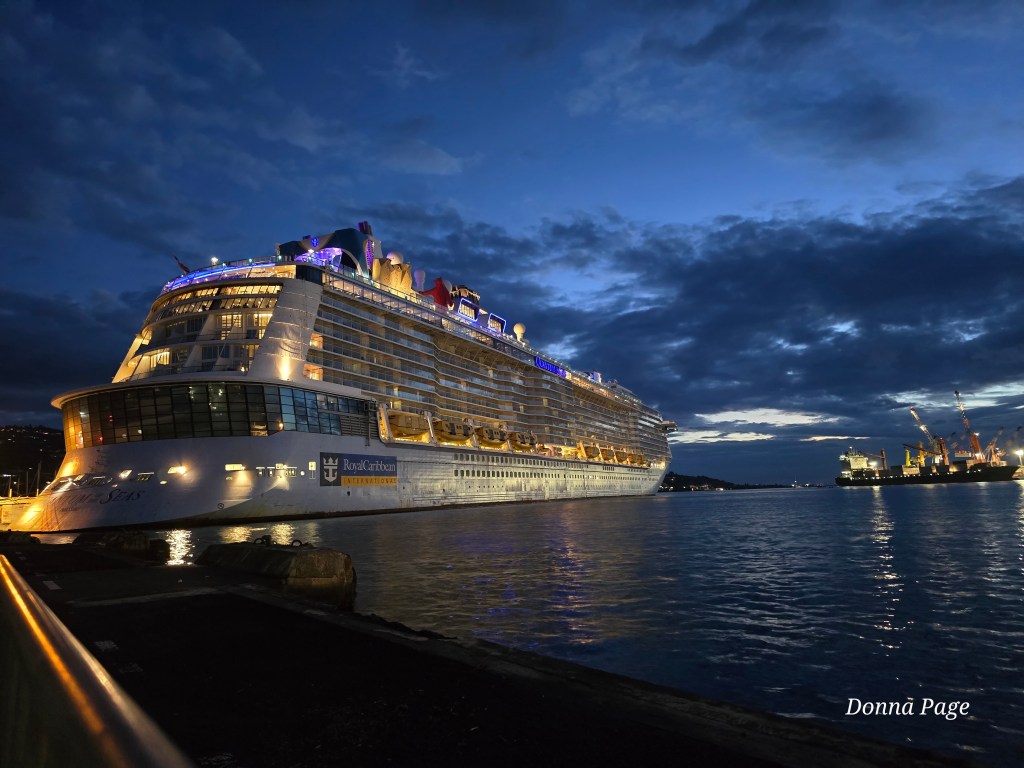
This is where we fast forward 50 years to 2019. I had never left Australia in all that time. Most people want to travel, but my urge was very specific. I needed to cruise. When friends invited us to cruise to Airlie Beach in north Queensland, Darin and I jumped on the opportunity. He had such itchy feet. We sailed on the Pacific Dawn, a ship in the P&O cruise line fleet. With big eyes and hopes, my husband and I boarded that ship at the Brisbane Cruise Terminal. To say we were excited is an understatement. He had the travel bug; this was never meant to be his only cruise.
Like any new cruiser, we did not know what to expect, so it was all fascinating. Boarding was easy; line up and wait your turn. The ship was staying in Australian waters, so we did not require specific travel documents. Luggage was handed in, and room cards were given out. Next step: find our room. We had booked an ocean-view cabin, as neither of us liked the idea of not having a window in our room.
We boarded on the same deck as our room. Four of us shared this room, and it was compact, to say the least. Bunk beds were on either side of the room, and two ladders blocked the way to the window. None of which mattered. This wasn’t a tiny porthole on this trip. The window was large, and we had an amazing ocean view, as the name suggested.
Four adults unpacking was a challenge in the space that we had. We didn’t care; we were on a ship sailing north, somewhere we had never been. I wouldn’t recommend four adults in that size room. It would work well if you put children up on the bunks. We certainly learned a lesson about four adults living in close quarters over those few days.
Our first cruise was about something other than the room; we only slept and dressed in there. It was about everything else that was going on. There were parties everywhere. The ship had several bars, dining rooms, and quiet spaces. A first cruise is go, go, go. It was easier on us as our friends were experienced cruisers. Every day on a ship is packed with things to do. There is absolutely no reason to be bored on board.
Trivia quickly became a favourite daytime thing to do, but in between trivia times, standing on the deck watching the ocean go by was amazing. Looking over the railing and watching dolphins play in the wake of the ship is an experience I will never forget and one I look for on every cruise now. Surprisingly to me, birds were flying around the ship. We couldn’t see land whilst we were sailing, so these birds were a long way from a nest, we were told they were Boobies. Another experience, we had never seen these birds before.
The days disappeared quickly with so much to do. A ship is a small metropolis. It takes around 1000 people to keep her going and the passengers well fed. The wait staff were incredibly well trained and efficient. Dinner was spent in a restaurant that was the main dining room but presented like an a la carte restaurant; the menu put several restaurants in Brisbane to shame. The service provided by the crew is amazing.
There were other choices of places to eat on board. The top deck had a dedicated bistro serviced by 5 different kitchens. You certainly never have an excuse to say you are underfed on a cruise in 2024, that’s for sure.
That four-day cruise ignited the flames in both of us. More cruises were booked. Sadly, events stopped those cruises from happening. COVID stopped cruising in its tracks, and by the time we could cruise again, my life had changed forever. So, my travels are now dedicated to the promise I made to live our dreams, keeping promises.



 Keeping Promises - A blog of travel, food, and stories.